
Gerbera is one of the most popular cut flowers in the world. With its large flower head, vibrant colours and cheerful appearance, this flower instantly brightens up your home. What’s more, it has a long vase life and is surprisingly versatile. Read on to discover everything there is to know about Gerbera!
Gerbera characteristics and flowering
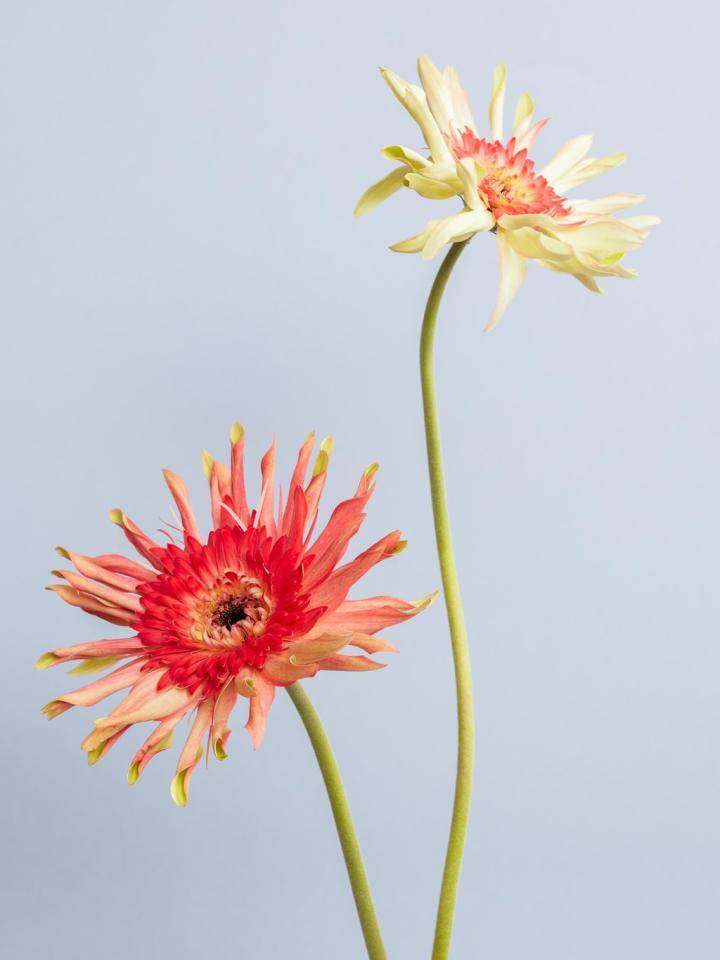
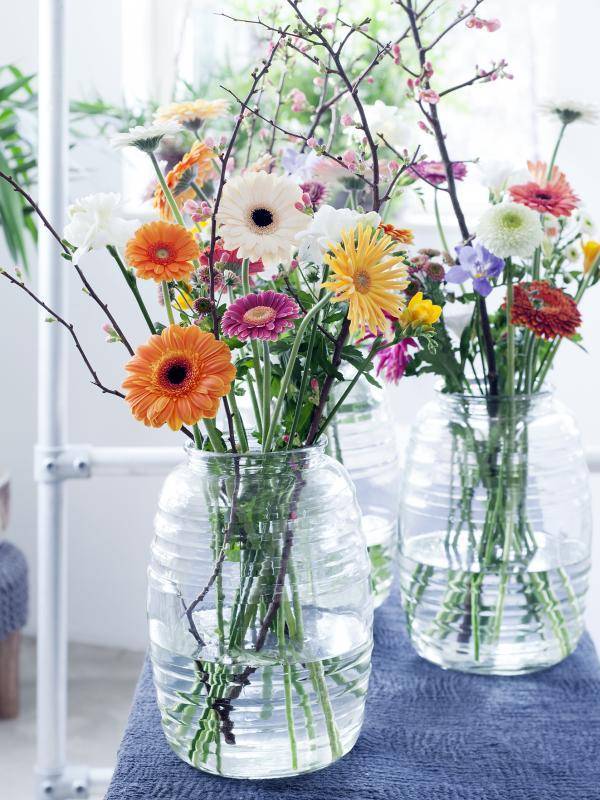
When you think of Gerbera, you think of colour! The main colours of Gerbera are red, yellow, pink, purple, orange, green and white. The flower also comes in two-tone and multicoloured varieties, as well as in a wide range of shades derived from these main colours. The beautiful centre of this flower can be black, yellow or green. Gerbera petals come in a wide variety of shapes. There are single and double-flowered Gerberas, as well as Gerberas with pompom-shaped and spider-shaped petals. Gerbera stems are long, soft (slightly hairy) and slender. Cut Gerbera stems do not have leaves.
Gerberas belong to the Daisy family (Asteraceae), which also includes flowers such as Chrysanthemum, Daisy and Aster. Gerberas are unscented flowers and, thanks to professional cultivation, are available all year round. As a garden plant, Gerberas generally flower from spring until the first frost arrives (October).
Caring for Gerberas in a vase
Brought home a bunch of Gerberas? Naturally, you’ll want to enjoy them for as long as possible. Gerberas are strong cut flowers with a long vase life. Check out these basic rules and tips for caring for flowers and follow the tips below to enjoy your Gerberas for as long as possible!
- Make sure your vase is clean
- Fill the vase with a small amount of water (3-5 centimetres)
- Cut Gerbera stems diagonally with a sharp, clean knife
- Refresh the vase water every 2-3 days
- Cut the stems diagonally again whenever you refresh the water. This helps prevent the stems from going limp.
- Don’t place Gerberas in a draught, in direct sunlight or near a radiator
- Don’t place Gerberas near a fruit bowl. The ethylene gas released by ripening fruit causes flowers to wilt more quickly.
Gerberas only need a small amount of water in the vase, as their stems are sensitive to bacterial growth. If Gerberas are given too much water, the stems soften more quickly and the flowers start to droop.
Arranging Gerberas in your vase: here’s how
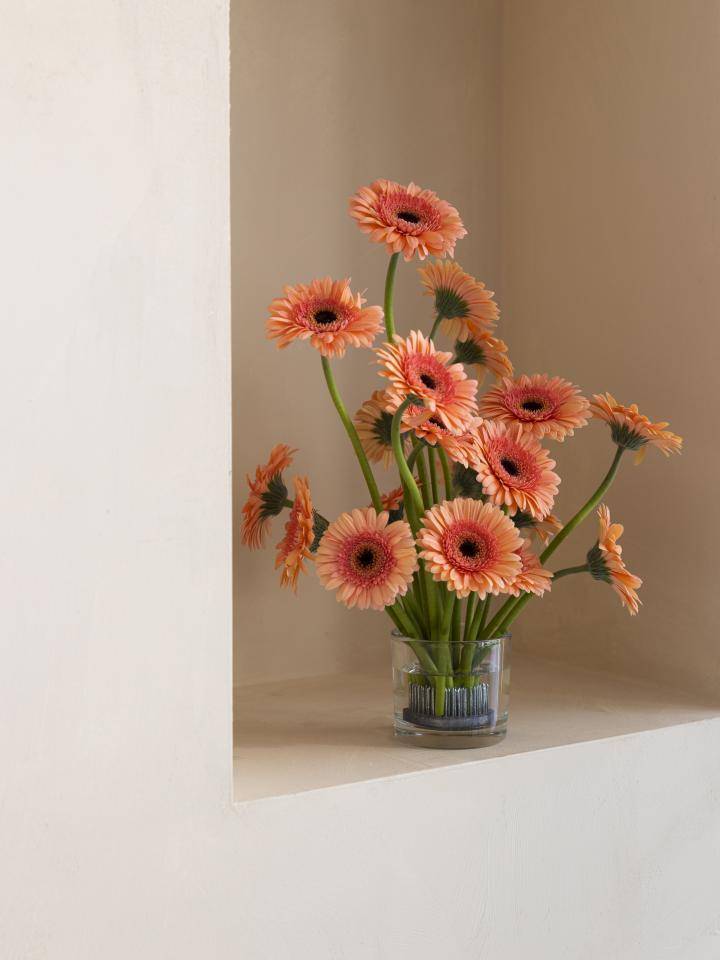
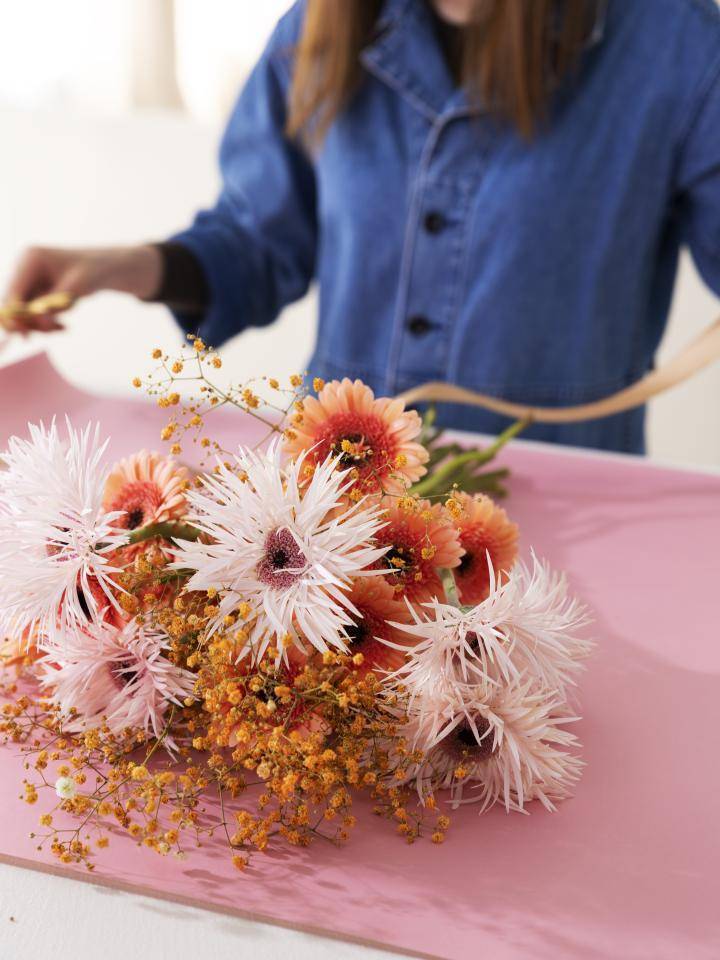
Gerbera combines beautifully with many other cut flowers in a mixed bouquet and also looks stunning as a mono bouquet (Gerberas only) in a vase. Of course, you can arrange your Gerberas in the usual way using these tips. But there are also other, more unusual ways to arrange your bouquet! How about these 3 original ways to arrange a bouquet, such as the Ikebana bouquet above with orange Gerberas arranged at playful, varying heights?
Gerbera as a garden plant
Although Gerberas are best known as cut flowers for the vase, they are also available as garden plants. For example, you can buy potted Gerberas or Gerbera seeds to plant yourself. Some Gerbera varieties are not winter-hardy, however, which means you’ll need to bring them indoors during winter to protect them from cold and frost. Want to find out more about caring for Gerbera as a garden plant? Take a look at this plant guide.
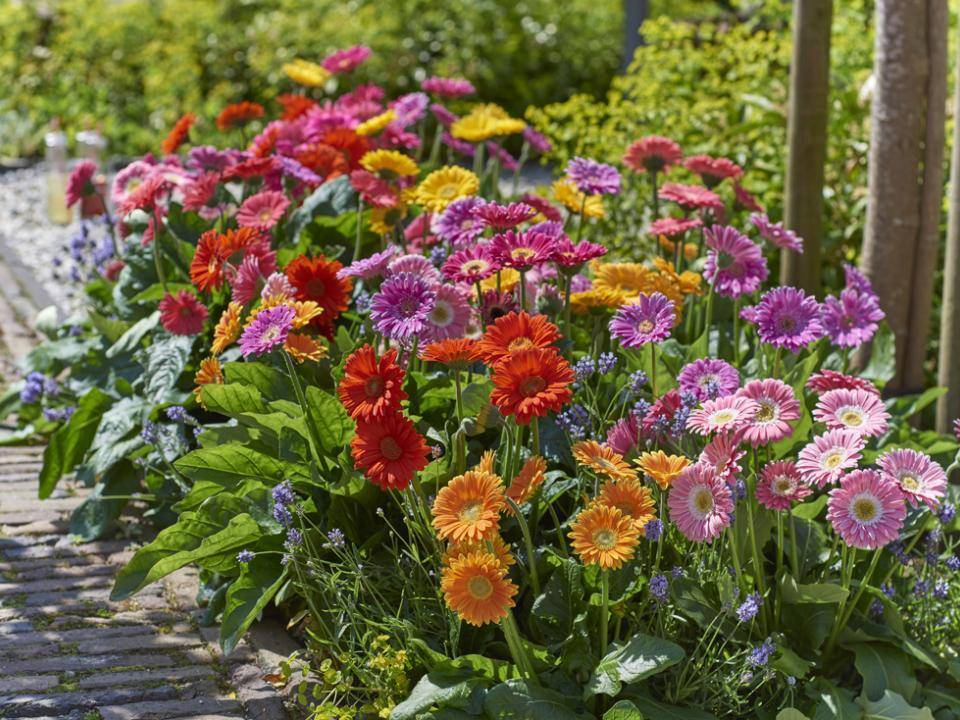
Broadly speaking, Gerberas can be divided into standard Gerberas and mini Gerberas, also known as Germini.
Types and shapes of (cut) Gerberas
There are around 30-40 botanical species of Gerbera, from which thousands of cultivars (cultivated varieties) have been developed for the cut flower industry. Broadly speaking, Gerberas can be divided into standard Gerberas (diameter 9-15 cm) and mini Gerberas (diameter 6-8 cm), also known as Germini.
Almost all Gerberas sold as cut flowers today are crosses, or hybrids, of different botanical species, such as Gerbera jamesonii and Gerbera viridifolia. The varieties mainly differ in shape. That’s why cut Gerberas are generally classified according to their flower shape:
- Single-flowered Gerberas: have one row of petals around a clearly visible flower centre.
- Semi-double Gerberas: have several rows of petals and a visible centre, although it is less prominent than in single-flowered Gerberas.
- Double Gerberas: have several rows of petals and are so densely packed with petals that the flower centre is less visible.
- Spider Gerberas: these Gerberas have narrow, elegantly curled petals that create a playful effect
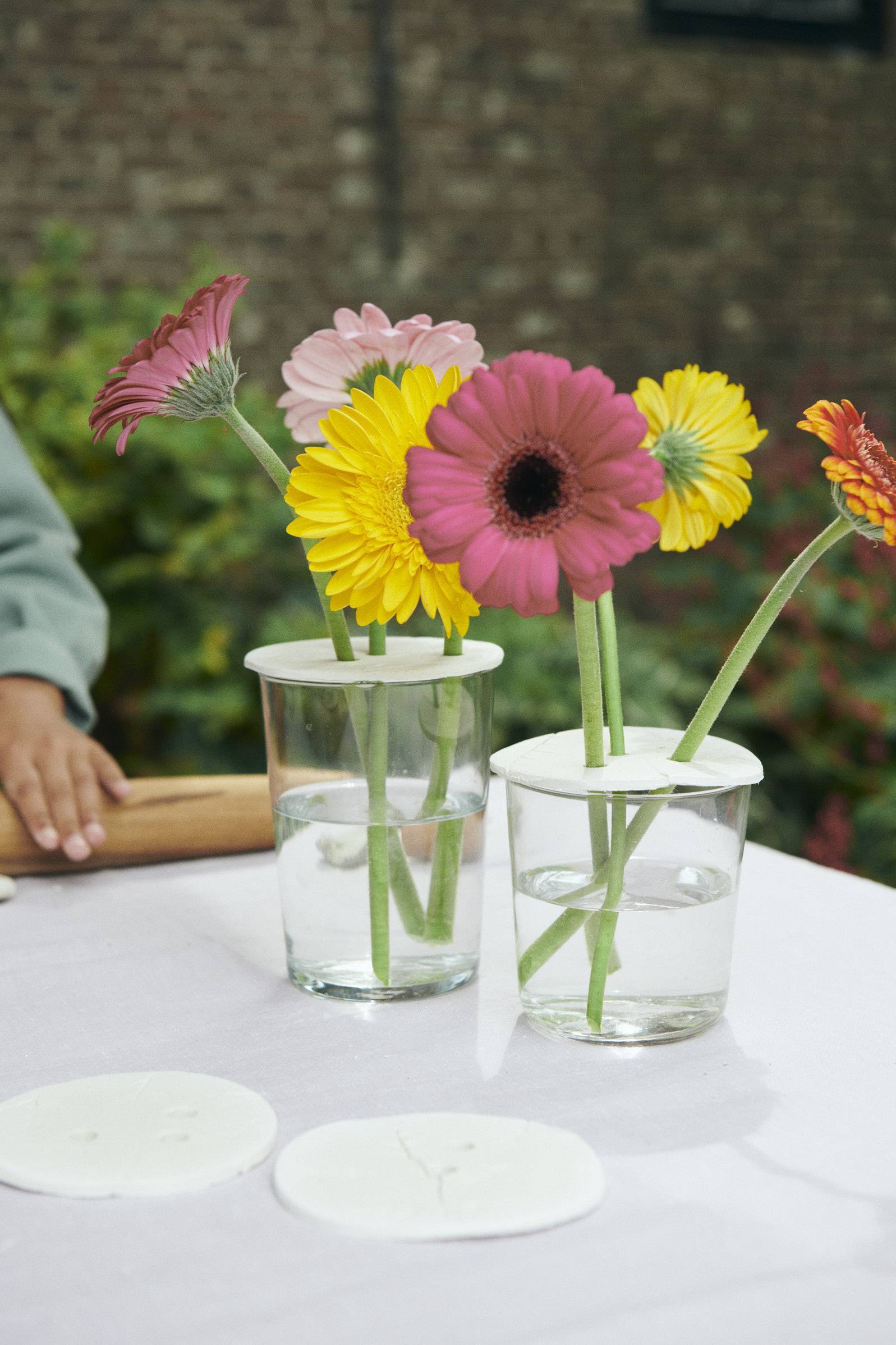
Different types of Gerberas
Is Gerbera poisonous?
No, Gerbera is known to be a non-toxic cut flower for people, dogs and cats. This makes the flower a safe choice for households with young children and pets.
How are Gerberas grown?
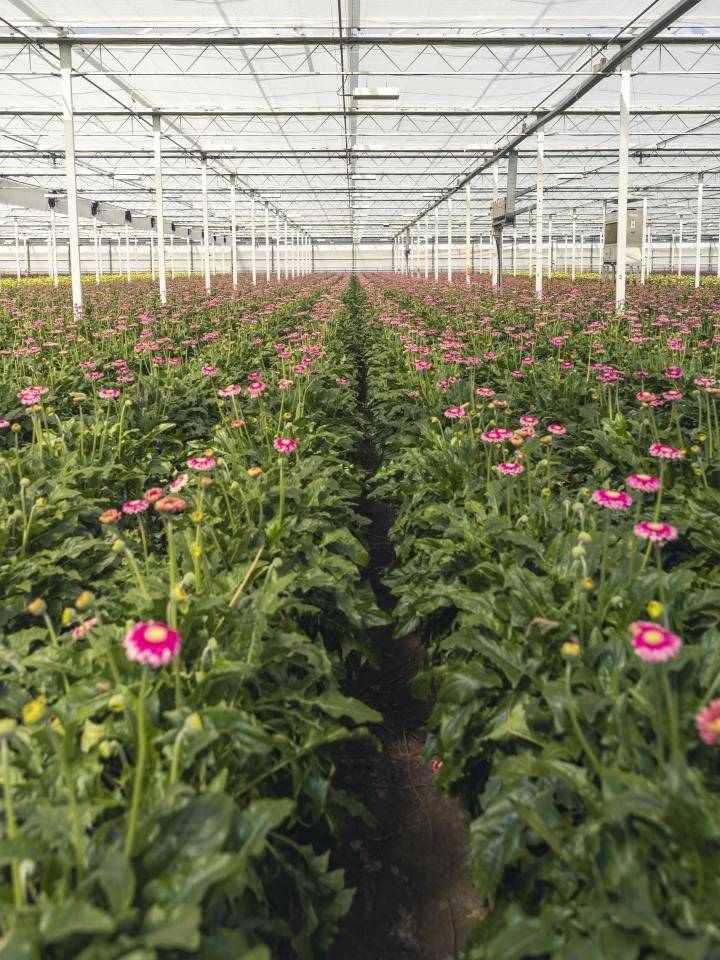
Around 900 million Gerberas are produced in the Netherlands every year, across 600 different varieties in a huge range of colours, shapes and sizes. This makes the Netherlands one of the world’s leading countries for Gerbera cultivation. Curious to see exactly how Gerberas are grown? Take a colourful look inside the greenhouse at LG Flowers, one of the largest Gerbera growers in the world. Across more than 120,000 m2 of growing space, LG Flowers produces around 95 million Gerberas every year in more than 80 shades! And they do so as sustainably as possible.

Symbolism of Gerbera
Gerbera is often seen as a symbol of cheerfulness, vitality, innocence and purity. Give someone Gerberas and you’re giving them a generous dose of positivity! And really, how could it be otherwise with such radiant little suns on stems?
Give Gerberas and you’re giving a generous dose of positivity!
Origin of Gerbera
Gerbera originates from South Africa, Asia, South America and Tasmania. In 1737, Gronovius, a Dutch botanist, published the first description of a plant resembling the Gerbera. However, it was the German botanist and researcher Traugott Gerber, a friend of the famous Swedish botanist Carl Linnaeus, who discovered the plant during an expedition to South Africa in 1735. The plant was later named after him in recognition of his discovery and contribution to botanical science.
After returning to Europe, the Gerbera was further researched and studied by various botanists. It wasn’t until the 19th century that Gerbera became popular in Europe. More and more varieties were developed, and today Gerbera is a much-loved cut flower and garden plant. The Netherlands is currently one of the leading countries when it comes to growing Gerberas.