
Written by
Sabina
Description
Indirect light
Moderate
Green
Easy to care for
Most plants earn their fame through either lush green leaves or colourful flowers. The Poinsettia, also known as Euphorbia pulcherrima, does things a little differently. In winter, this cheerful plant transforms with spectacular coloured leaves that brighten even the greyest days. From care and ideal placement to the story behind its symbolism. Discover everything you need to know about the Poinsettia and wave goodbye to that winter slump!

Characteristics of the Poinsettia
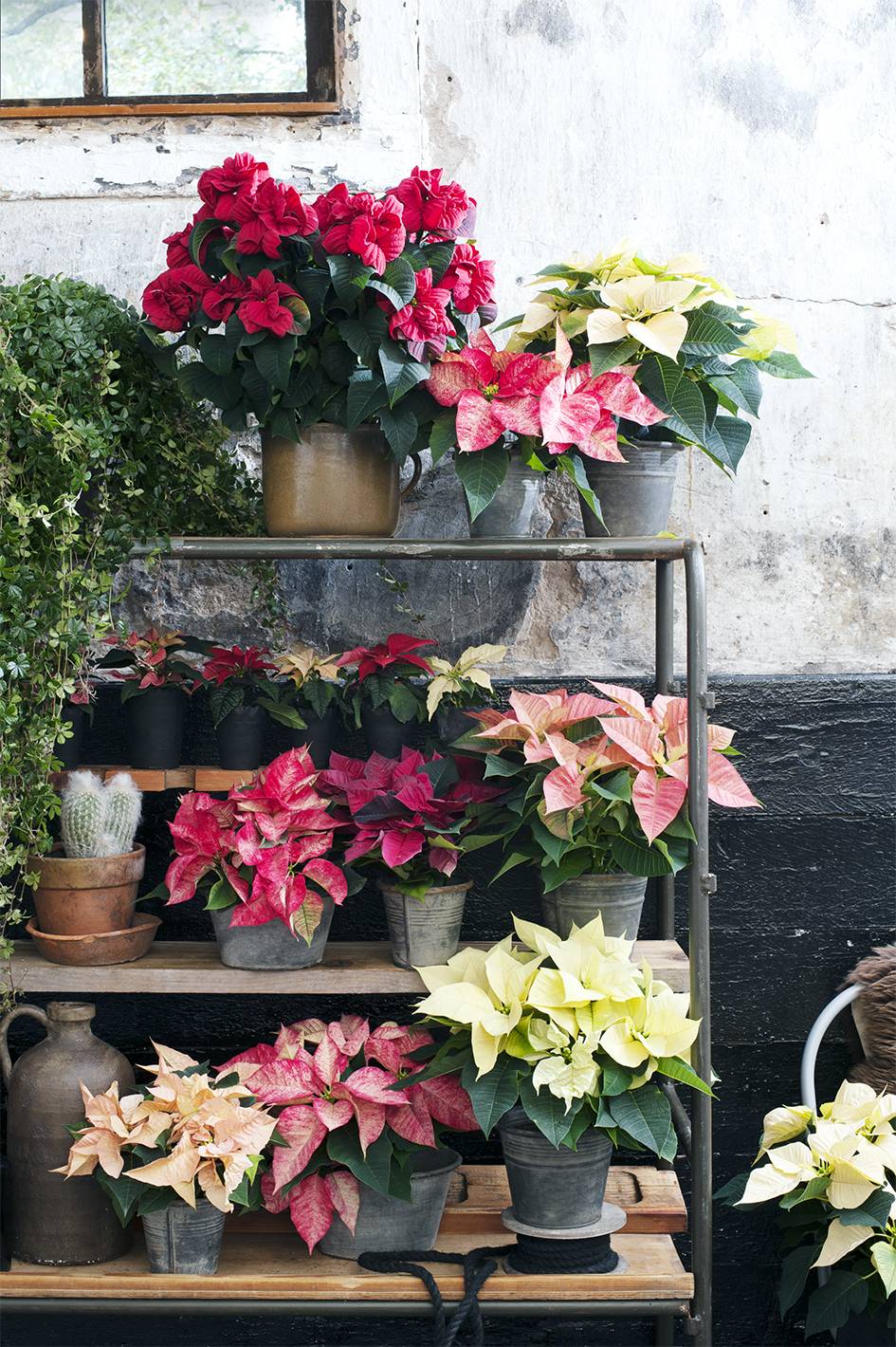
The Poinsettia has large, oval, green leaves. In winter, it produces tiny yellow-green flowers surrounded by its famous bracts in vivid colours. You used to see mostly red varieties, yet cream, soft yellow and salmon pink are now just as common. And if you are lucky, you may even spot a variegated or marbled version.
The Poinsettia belongs to the spurge family, Euphorbiaceae, which also includes plants like Crown-of-thorns and Castor Bean.
When does the Poinsettia bloom?
The Poinsettia blooms from November to January. Combined with its star-shaped form and often red colour, this has made it a true symbol of the festive season. The plant’s striking “bloom” is not created by flower petals, but by coloured bracts that change in winter. The actual flowers are yellow-green, small and rather discreet.

Poinsettia care and ideal spot
- The Poinsettia is sensitive to cold and draughts. Make sure it is wrapped warmly when travelling from shop to home.
- Use paper or another protective layer to keep the cold at bay.
- Place your plant somewhere out of the draught and where the temperature stays as stable as possible.
- The ideal room temperature is between 18 and 22°C.
- Avoid dry air, so do not place the plant too close to central heating.
- Choose a bright spot, but keep it out of direct sunlight.
- A flowering Poinsettia prefers slightly moist soil. Lightly misting the plant now and then can help.
- Feed the plant every two to three weeks to keep it in top condition. If any sap gets on your hands, wash it off. The milky sap can cause mild skin irritation.
The Poinsettia is sensitive to cold and draughts. Make sure it is wrapped warmly when travelling from shop to home
Which cultivars of Poinsettia exist?
There are now more than 200 cultivars of Poinsettia, varying in colour, leaf shape and size.
These are some of the most popular ones:
- Red Poinsettia: The classic and most widely known type with deep red bracts. Well-known varieties include ‘Christmas Feeling Red’ and ‘Premium Red’.
- White and cream Poinsettia: Popular varieties include ‘Princettia White’ and ‘Alaska’.
- Pink Poinsettia: Think of ‘Pink Elf’ and ‘Lilo Pink’.
- Bicolour varieties: These have speckled, marbled or two-tone bracts, such as ‘Ice Punch’ and ‘Jingle Bells’.
- Mini Poinsettias: Compact, rosette-like varieties that are perfect for the Christmas table. ‘Winter Rose’ is a well-known example.
*Good to know: Euphorbia pulcherrima is the only botanical species known as Poinsettia. Unlike many other plants, there are no separate botanical species within this group. The differences lie entirely in the cultivars.


Is the Poinsettia poisonous?
Yes, the Poinsettia is mildly toxic when ingested by both pets and humans. Like many plants in the spurge family, it contains milky sap that can cause mild symptoms such as nausea or stomach upset if eaten.
If the sap touches your skin, it may cause slight irritation such as redness or itching. Wash your hands if any sap has leaked from a stem.
Symbolism of the Poinsettia
Because of its star-like shape, frequent red colour and winter blooming period, the Poinsettia is strongly associated with December and Christmas worldwide. It symbolises joy, festivity and vitality.
In Christianity, the red leaves are sometimes seen as a reference to the blood of Christ and symbolise love and sacrifice. In some cultures, the Poinsettia also represents a fresh start and is linked to the transition from the old year into the new one.

Where does the Poinsettia come from?
The name Poinsettia comes from American botanist Joel Poinsett, who served as US ambassador to Mexico between 1825 and 1829. During his time there, he discovered the plant and sent it home every year as a gift to his family. It soon became a symbol of love and good wishes. In the United States, his day of death, 12 December, is even celebrated as Poinsettia Day. It is customary to give each other a plant on that day.
However, it was not Poinsett but nurseryman Robert Buist who first cultivated the plant on a large scale and made it widely popular. Although Buist sold it under its botanical name Euphorbia pulcherrima, people continued to call it Poinsettia as a tribute to Joel Poinsett.
In the wild, the Poinsettia grows in moist subtropical mountain regions of Central America. Not as a petite houseplant, but as a shrub that can reach four metres in height. It blooms from November to February, then sheds its leaves and spends the rest of the year looking rather bare.